

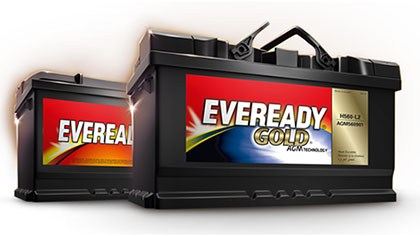
Al Muqarram Auto Parts (A-MAP) has expanded its product range by obtaining the distribution rights of Eveready Batteries in the UAE. Eveready batteries are made to the highest quality standards in the Johnson Controls factory in Europe. These batteries are designed to deliver long battery life performance through optimized grid design using the most modern European manufacturing technologies. With over 15 years experience, A-MAP is a global market leader, specializing in the distribution of quality and reliable aftermarket automotive spare parts. A-MAP has a series of successful and well-known trusted brands worldwide, among them being Solite Batteries, Sebang Batteries, Hyundai Xteer Lubricants, Asimco Brake Pads, Achilles Tyres and RBI Rubber Parts. With the headquarters operating in Dubai, A-MAP has a network of branches fully operational in China, South Africa and Qatar. Our global network is continuously expanding due to our perfection and quality of products.
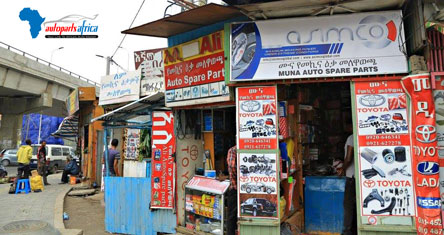
A-MAP launches promotional campaign in Ethiopia to promote ASIMCO auto parts
folder_open Market Reports
In an effort to further increase the popularity and reach of ASIMCO auto parts in Ethiopia, Al Muqarram Auto Parts (A-MAP) has launched aggressive promotional campaign in Ethiopia. An extensive advertising and marketing campaign to promote ASIMCO automotive spare parts in the Ethiopian market has been launched by A-MAP. As a result, ASIMCO shop boards and posters are now visible across Ethiopia in auto service centers as well as spare parts shops. Ethiopia is one of Africa's fastest growing economies and has the continent's second largest population. Asimco has established a precedence for developing and manufacturing premium friction products. Asimco is highly recognized for its excellent quality products since its introduction to the market in 2001. Products under its portfolio include brake pads, brake shoes, fuel pump, brake fluid, disc rotor and shock absorber. Over the years, Asimco’s quality supported the strong growth in market share and sold in almost 65 countries. Asimco Brake pads and shoes are designed to give drivers amazing brake feel with the longevity you expect from a premium brake product. Asimco product is sold as a kit when servicing a vehicle, it includes premium shims manufactured by MSC to reduce braking harmonics to almost an inaudible level. Where applicable hardware is provided and anodized to increase the life of accessory components to prevent rust and various road conditions from degrading the products life span. With over 15 years experience, A-MAP has emerged as a global market leader, specializing in the distribution of quality and reliable aftermarket automotive spare parts. A-MAP not only distributes products, it distributes excellence. A-MAP has a series of successful and well known trusted brands worldwide, among them being Solite Batteries, Sebang Batteries, Hyundai Xteer Lubricants, Asimco Brake Pads, Achilles Tyres and RBI Rubber Parts. With the headquarters operating in Dubai, A-MAP has a network of branches fully operational in China, South Africa and Qatar. The company aims to continuously expanding due to our perfection and quality of products. Asimco also participated in an auto exhibition in Tanzania from 16 - 18 August in an effort to reach buyers from East & Central Africa. Despite the poor footfall at the event, Al Muqarram Auto Parts was able to forge business alliances with key players in the East Africa market through their marketing and networking efforts. Asimco brand of auto parts are popular with African users because of their high quality and competitive pricing. Promotional activities undertaken by Al Muqarram Auto Parts (A-MAP) in the African market have further consolidated ASIMCO auto parts as the number one brand of choice for African customers.
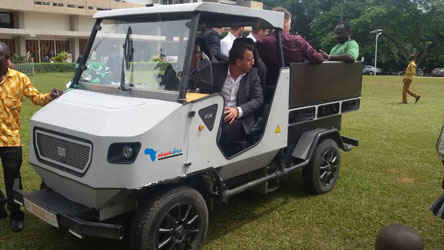
A vehicle that is powered by the sun, that is the latest invention by students of Ghana’s Premier engineering university, the Kwame Nkrumah University of Science and Technology (KNUST) located in the resource rich Ashanti region. The first version of the environmentally friendly automobile was outdoored recently at a graduation ceremony of the university. The invention of the 4×4 vehicle was in partnership with the Technical University of Munich. It was developed by the Departments of Mechanical Engineering and Physics, and is seen as a breakthrough for the West African nation as it explores ways to build a more robust automobile industry. Most cars in the country are fuel based, either diesel or petrol run, a few others use Liquefied Petroleum Gas (LPG). Ghana discovered oil along its western coast but still imports refined fuel for industrial and commercial use. The pickup-styled vehicle as displayed at the event seats two persons at a time. The first drive was taken by the chancellor of the university and powerful Ashanti king, Otumfuor Osei Tutu II and one of the guests who had graced the graduation ceremony. The monarch drove it round a small field to much admiration of graduating students and other people who had gathered for the event. He went on to task the government to support the effort of the university to undertake more of such innovations.
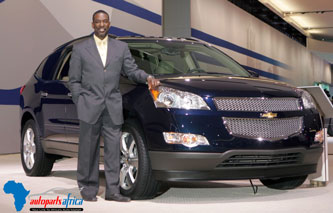
Formed in 2015, the Africa Association of Automotive Manufacturers (AAAM) works specifically to promote and facilitate the growth of the African automotive industry. Formed by executives from the world’s biggest car manufacturers, the African Association of Automotive Manufacturers (AAAM) embarked on a concerted push to revive and resurrect Africa’s auto industry. Since then, the newly-created African Association of Automotive Manufacturers (AAAM) has been working with key African governments to create the right policy environment for the sector to ?ourish. Not surprisingly, one of the organisation’s ?rst ports of call was government leaders in Nigeria’s capital Abuja. Fast-growing Nigeria is the jewel in Africa’s auto crown with just 44 vehicles per 1,000 inhabitants, far below the global average of 180 vehicles per 1,000 inhabitants, according to recent estimates by a Deloitte report. While new vehicle sales have jumped in developing markets like China, India and Brazil over the last decade, growth in Africa has remained relatively slow. According to the International Organisation of Motor Vehicle Manufacturers (OICA), only 1.5 million new vehicles were sold across the African continent’s 54 countries with a combined population of 1 billion in 2016. South African consumers buy most new cars, and together with Egypt, Algeria and Morocco account for almost 80 per cent of the continent’s total auto sales, with only muted demand from important economies like Nigeria and Kenya. But far from being a disincentive to investors, the ?gures act as a rallying call. “When Volkswagen and General Motors moved into China the motorisation rate was lower than in Ethiopia today. The limited market was not a deterrent for the early movers who recognised China’s long-term potential,” says Karthi Pillay, Africa automotive leader, risk advisory at Deloitte. Africa’s untapped demand combines with a steady increase in consumer spending which has been rising at an annual rate of 10 per cent over the last few years. Moreover, analysts predict that by 2030, over half a billion Africans will have joined the middle class. “If the growth in vehicle sales keeps pace with growing consumer spending, annual sales of passenger cars in Sub-Saharan Africa will surpass 10 million units by 2030,” says South African consultancy B&M Analysts. Mix with this a renewed determination amongst African leaders to diversify their economies through boosting manufacturing. New policies aimed at increasing domestic car production are starting to pay off. In 2016, China’s state-owned car manufacturer Beijing Automotive International Corp unveiled plans to build a R11bn (US$759mn) auto plant in South Africa – the biggest investment in a vehicle-production facility in the country in four decades will earmark over half of its output for export, initially to East, West and North Africa. Elsewhere, after a four-decade break in production, Volkswagen is starting up its Kenyan production line once again. The signs are good. But with challenges ranging from imported used cars ?ooding the market to Africa’s weak manufacturing base and a lack of ?nance for would-be car owners, Africa promises a challenging operating environment. USED CARS THRIVE IN AFRICA The biggest barrier to new vehicle sales in Africa is cheap, imported second-hand cars from the US, Europe and Japan. Consultancy Deloitte estimates that eight out of 10 imported cars in Ethiopia, Kenya and Nigeria are used cars. According to the Kenya National Bureau of Statistics (KNBS) the volume of imported vehicles between 2005 and 2017 grew at over 300 per cent from 33,000 to over 120,000 units. Governments are developing policies to limit the in?ux. In an effort to hike the price of second-hand cars to favour more new car purchases, Kenya has forbidden vehicles over eight years old from entering into the country, with plans to reduce this further. Similarly, Nigeria has increased its import duty on second-hand vehicles, most of which arrive in a bustling trade from the US into Africa via Benin’s Cotonou port. As a result, Nigeria’s imports of cars from the US plummeted from more than 100,000 a year to less than 40,000 units in 2015. Other signs of change include the enduring stagnation of the Japanese economy. It has resulted in sluggish sales of new cars there, which in turn has created a shortage in the supply of quality used vehicles. There has been “a deterioration of the environment surrounding the export of the used motor vehicles industry”, says Hiroshi Sato, chairman of the Japan Used Motor Vehicle Exporters Association. As crucial as controlling used-car imports is to nurturing a domestic industry, so is establishing a manufacturing base. South Africa leads the continent’s auto manufacturing sector with original equipment manufacturers, long-established in the country and backed by a vibrant community of 500 suppliers and diversi?ed manufacturers. Yet, head up the continent and there is little auto manufacturing until North Africa, bar light manufacturing from imported kits. Kenya only has three assembly plants, and they all produce vehicles with wholly imported parts that require no domestic manufacturing input. The Kenyan government, which has identi?ed the auto sector as a key driver of the country’s industrialisation policy, has promised incentives to encourage a local industry. These include building special economic zones which bene?t from tax holidays and low utility rates. It has also introduced local input requirements and tariffs on imported auto components that could be manufactured locally. Encouragingly, the assembly of motor vehicles in Kenya grew by 31.4% from 2013 to 2014, with assembly ?gures forecast to almost double between 2013 and 2019. It’s improving the country’s chances of becoming a hub for assembly and production in the region. It’s a similar story in Nigeria, where the Automotive Industry Development Plan (NAIDP) pledges to build auto industry infrastructure including supplier parks and clusters. Tax incentives include Nigeria allowing car groups to import two fully-built units at a discount duty of 35 per cent for cars and 20 per cent for commercial vehicles, for every one built locally. The government also aims to boost skills and investment and encourage a local component industry to supply manufacturers at competitive prices. It amounts to the kinds of incentives that encouraged Ford to begin assembling its Ford Ranger pickup in the Nigerian city of Ikeja in 2015, partnering with Ford dealer group Coscharis Motors on the project. “Nigeria is a priority market for us in Sub-Saharan Africa and this will allow us to better serve our customers, both from a retail point of view and in terms of vehicle and parts availability,” says Jeff Nemeth, president and CEO of Ford Motor Company of Sub-Saharan Africa. “We are committed to supporting Nigeria’s developing automotive industry and economy together with Coscharis, and are looking forward to being active in the community. New assembly operations, even on a smaller scale like this one, have very positive ripple effects in the local economy and workforce.” But nurturing indigenous manufacturing is still dif?cult. Nigeria-based groups Nissan and Peugeot also only assemble the bulk of their vehicles from imported semi-knocked down (SKD) kits because there is no local manufacturing industry. Even Nigeria’s own Innoson Vehicle Manufacturing Company (IVM) based in the south-eastern Anambra state, assembles trucks and buses with completely knocked-down (CKD) kits with all the vehicles’ engines, gear boxes and electrical parts imported from overseas. Auto-related imports into Nigeria accounted for around 11.5% of total imports, worth around US$6.9bn in 2014, according to UNCTAD. AFRICA'S AUTOMOTIVE SECTOR Nigerian policy is currently making things even more dif?cult. Like all manufacturing, the auto sector is struggling under currency policies and associated import controls set up to conserve hard currency – and encourage local manufacturing – by prioritising strategic imports. It’s starving the auto sector of inputs and leading to a collapse in supplies of product lines from glass to rubber. OICA estimates that total new vehicle sales in Nigeria dropped by more than half in 2017, compared to 2016. It’s this kind of foreign exchange controls that are also limiting the ability of companies to import SKD units and parts for assembly and repair in Ethiopia, where high taxes also make cars unaffordable for most. Exporting within Africa is also a challenge for the continent’s carmakers because of tariffs and barriers. Uganda and Tanzania slap tariffs on cars assembled in Kenya, the only country in the East African Community with assembly capability, because they don’t meet local input criteria. It gives imported second-hand cars the edge. In recent times, Toyota South Africa saw a fall in exports to the rest of the continent as a result of higher tariffs in Nigeria, Algeria and Angola. Meanwhile, South Africa exports more vehicles to Europe, the US and even Asia than it does to its neighbouring African market. “Vehicle exports to Europe and Asia continued to show growth. Vehicle exports to African markets recorded substantial declines. This was due to a combination of factors including ad hoc duty increases in Nigeria and Zimbabwe, regulatory restrictions in Algeria and weaker economic conditions across most African countries due to the decline in commodity prices,” says Nico Vermeulen, director of the National Association of Automobile Manufacturers of South Africa (NAAMSA). FINANCING NEW CARS IN AFRICA Governments also need to create easier access to car ?nance. “The availability of ?nancing for new motor vehicles is virtually non-existent in most African countries,” says Vermeulen. South African banks have been quickest off the mark. South Africa’s FirstRand Bank announced plans to set up a vehicle ?nancing arm in Nigeria via its subsidiary WesBank, Sub-Saharan Africa’s largest provider of auto loans. Meanwhile, First Bank of Nigeria has spotted opportunity in the growth of car sharing in Nigeria in a development that the architects trying to build demand for new cars can hardly welcome. The bank’s vehicle ?nancing arm plans to extend borrowing to highly-rated Uber drivers via low-interest, used vehicle loans. The car-sharing platform has operated in Abuja and Lagos since it entered the Nigerian market in 2014. It currently has more than 2,000 drivers and was targeting 4,000 by the end of 2016. “We are absolutely committed to making it as easy as possible for our driver partners to start and maintain their own successful and pro?table businesses,” says Ebi Atawodi, general manager of Uber Nigeria. “And these used vehicle ?nance options make it possible for those with a demonstrable performance commitment to build sustainable businesses without incurring the high costs often associated with new vehicle purchases.” The growth in car sharing in Nigeria leads Deloitte’s Pillay to ponder future developments in the industry. “It shows mobility leapfrogging car ownership; Africa may not be a market focused on making and selling cars,” he suggests. Indian and Chinese manufacturers believe their low-cost models will have the advantage, while others are betting on the electric car. Uganda’s Kiira Motors grew out of a research project at Makerere University and is aiming to produce electric vehicles by 2019 before becoming original manufacturers by 2039. Ford is expanding its multi-modal approach to urban mobility. One of the innovations on show at Go Further Africa was its electric MoDe:Pro e-bike. Whatever the future holds, Africa’s consumers are the last untapped market for the auto giants.
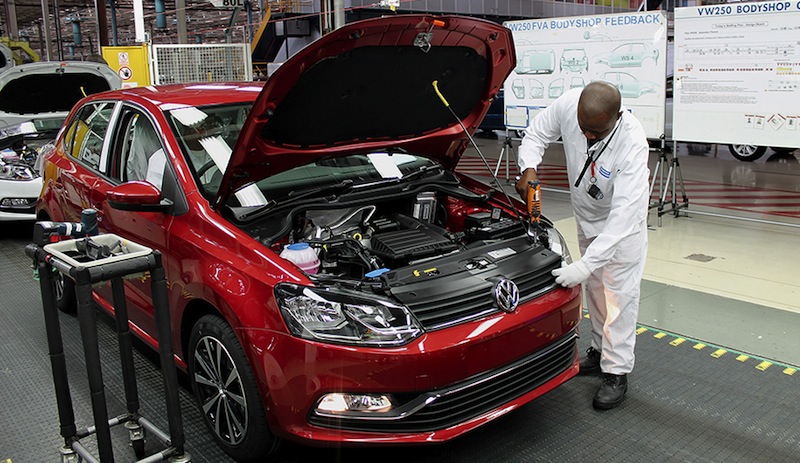
Volkswagen, the leading German automaker is aiming to double production and introduce a new model in Kenya. VW’s South Africa chief Thomas Schaefer told President Uhuru Kenyatta at a meeting that “the firm was exploring producing a second model in Kenya, possibly a hatchback – small SUV – while doubling production of the VW Polo Vivo to at least 300 vehicles,” Developing the automotive industry is the most important component of the President’s industrialization agenda. President Uhuru welcomed VW’s commitment to the development of its Kenya facility, saying that the country had a ready market for cars made in Kenya, provided that they were sold at affordable prices. “We will walk this journey with you to produce affordable cars. Our plea is that you price these vehicles reasonably,” the President said. President Uhuru added “We are very keen that our youth, a highly educated group, can get to work in a company of great technological sophistication as VW, which is why we welcome your plans to go full throttle to increase production,” He looks forward to a successful operation in Kenya, Nigeria and South Africa. Kenya aims to produce a major auto manufacturing plant, with the capacity to meet the supply needs of East and Central Africa. VW was set up in Kenya in 2016, and its first car was out less than a year later. In 2015, Japanese car manufacturer Toyota started assembling some models while last year, French automaker Peugeot started manufacturing cars in Kenya. Volkswagen opened a new assembly plant in Kenya in 2016 and launched plans for a ride-sharing service in Rwanda as it seeks to take advantage of surging car demand in Africa. "Overall car sales in Africa are bound to rise by 40 percent within the next five years, that is why we are expanding our business," said Volkswagen Brand CEO Herbert Diess. Passenger vehicles were Kenya's fourth-largest import and the volume of imported cars grew 300 percent in the last decade. Many of the imports are second-hand cars from Japan or the United Arab Emirates. PROJECT RWANDA Part of the project also involves the construction of an assembly plant in Kigali. Tiny Rwanda has no established vehicle industry, but it does have a population with an average of less than 20 years old and a commitment to clean energy. Volkswagen said it was also considering introducing electric cars into the country. "Rwanda is well-suited to be a pioneer of new mobility solutions as it has a population of young tech-savvy people and its capital Kigali is seen as the most connected city in Africa," said Schaefer. An investigation phase will last until May next year and the company aims to have the first cars assembled in Rwanda by the end of 2017. As in Kenya, the amount of the investment and production capacity have not been revealed. Deloitte sees Africa as the "final frontier" for the global automotive industry, with its enormous growth potential. The motorisation rate on the continent is only 44 vehicles per 1,000 inhabitants compared to a global average of 180 vehicles per 1,000 inhabitants. There were 300,000 cars in Rwanda last year, in a country of 12 million people, the CEO of the Rwanda Development Board, Clare Akamanzi, said as she welcomed the deal. Most of the cars on the roads are second-hand imports from countries such as Japan.
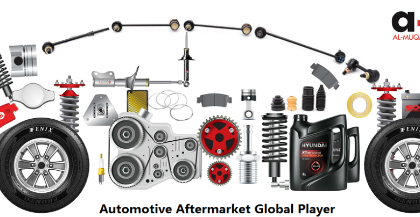
Al Muqarram Auto Spare Parts Trading
folder_open Auto Parts , Market Reports
Established in 1995, Al Muqarram Auto Spare Parts Trading has emerged as one of the largest suppliers of all kinds of automobile spare parts and batteries to many African countries. Located in the heart of Dubai's main business district near Al Nasr Square, the company has a wide range of products to meet the varying demands of its vast clientele across the world. Customers looking for a reliable source for any type of auto spare parts will be impressed by the comprehensive range of products in the company's inventory. Some of the popular products in stock with Al Muqarram Auto Spare Parts Trading include Solite batteries, Asimco brake pads and brake shoes, RBI Rubber parts, Sebang batteries, Malcorp axle boots and steering boots. In addition to these, the company also deals in driveshaft boots, steering boots, suspension bushings, engine bushings, arm bushings, shock absorber boots, engine mountings, stabilizer shaft rubber and shock dust covers. Al Muqarram Auto Spare Parts Trading has been exporting various kinds of automobile spare parts to many African countries like Kenya, Ethiopia, Nigeria, Tanzania, Ghana, Uganda, South Africa, Cameroon and Mali. "We have been able to build a loyal and satisfied clientele in Africa because of the high quality and low prices of our goods," says Asad Abbas Badami, Director of Al Muqarram Auto Spare Parts Trading. Ready availability of goods backed by a reliable and efficient distribution network has further helped the company to penetrate the emerging markets around the world. In addition to automobile spare parts, Al Muqarram Auto Spare Parts Trading also supplies batteries. Some of the major battery brands available at Al Muqarram Auto Spare Parts Trading include Solite Batteries and Sebang Batteries. The batteries division of Al Muqarram Auto Spare Parts Trading deals in a number of other popular brands that already have an established market in many African countries. The company's expansive product range makes it possible for customers to source all their requirements from one source. Competitive prices offered by Al Muqarram Auto Spare Parts Trading has further helped the company to establish its products in the emerging markets of Africa. With such a comprehensive product range and an efficient and well-knit distribution network, Al Muqarram Auto Spare Parts Trading has been able to establish itself as one of the leading suppliers of automobile spare parts. Also readily available with Al Muqarram Auto Spare Parts Trading are all kinds of filters - fuel injector filters, oils filters, element filter kits and diesel filters. Not to mention a wide variety of clutch plates, clutch covers, and disc rotors. The vast range of automobile spare parts available at Al Muqarram Auto Spare Parts Trading covers almost all major Japanese and Korean automobiles and are extremely popular with African customers because of our competitive prices and high quality. AUTOMOTIVE BATTERIES Solite Solite is a highly reliable automotive battery that satisfies the car lovers all over the world under any circumstance. The internal rust-free calcium metal exhibits the excellent heat resistibility and the strong immunity against drastic temperamental change. It is a maintenance free product that needs no refilling of the electrolytic solutions. Now the new era begins with Solite. Solite Batteries are getting increasingly popular amongst importers in Africa and A-MAP has been exporting Solite Batteries to many African markets in increasing quantities in recent years. Eveready Batteries A-MAP has expanded its product range by obtaining the distribution rights of Eveready Batteries in the UAE. Eveready batteries are made to the highest quality standards in the Johnson Controls factory in Europe. These batteries are designed to deliver long battery life performance through optimized grid design using the most modern European manufacturing technologies. These batteries are specially popular with African consumers because of their high quality and competitive pricing. Sebang Batteries Original equipment manufacturer Sebang, is a leading player in manufacturing premium quality batteries. These batteries are sealed maintenance free; they are designed for slow charge and slow discharge. It is the Original Equipment Manufacturer (OEM) for many leading automotive brands including Volkswagen India. Super Charge Gold Batteries Super Charge Gold batteries are manufactured in Indonesia with the standards of JIS and DIN type specifications, and are renowned for its composition of being the most reliable dry charge battery known in the world of batteries. SPARE PARTS Asimco Asimco has established a precedent for developing and manufacturing premium friction products. Asimco is highly recognized for its excellent quality products since its introduction to the automotive market in 2001. Products under its portfolio include brake pads, brake shoes, fuel pump, brake fluid, disc rotor and shock absorber. Over the years, Asimco's quality supported the strong growth in market share and sold in almost 65 countries. LUBRICANTS HYUNDAI XTeer HYUNDAI XTeer is one of the premium brand of high quality lubricants with a wide range of products that meets the specialized needs of the customers. HYUNDAI XTeer is committed to providing its users with the most comprehensive technical solutions that suit their lubrication needs for automotive and industrial purposes. HYUNDAI XTeer Lubricants are unique in the marketplace because of its leading edge technology of products, expertise of employees, and factory direct supply channels that provide service and value to meet customers' expectations. HYUNDAI XTeer Range of Products: 1. High performance Diesel Engine Oil for highly stressed turbocharged engines for light & heavy trucks, which gives high performance even with high sulphur fuels meeting API CJ standards. 2. High quality, low ash Gasoline Engine Oil, meeting API SN / ILSAC GF- 5 standards used for all passenger vehicles with with catalytic converters facing severe operating conditions. 3. Complete range of industrial lubricants and greases to meet the demands of the consumers willing to operate on reduced maintenance costs and less equipment maintenance downtime. TYRES Achilles Tyres Achilles is one of the premium tyre brands of Indonesia with a very rich history. At A MAP, we are supplying and distributing an extensive range of Achilles tyres such as Achilles Platinum, Achilles Desert Hawk Uhp and Achilles Atr Sport to assure high performance of your fleet. Achilles is made in Indonesia by PT. Multistrada Arah Sarana which was established in 1991. Launched in 2005 and starting out in the replacement industry, Achilles has developed a trusting relationship with affiliated companies becoming OE providers for Mitsubishi motors, Hyundai, Daihatsu, Hino and proton in Indonesia. Achilles was able to capture 15% of market share in Indonesia and additionally, had market coverage of 89 countries by the end of 2012. As a growing factory, Achilles is committed to providing the best tire for all the markets around the world.
Nigeria's Booming Automobile Sector
folder_open Market Reports , West Africa
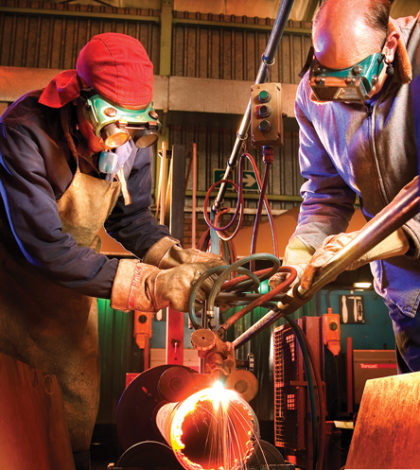
In a bid to encourage vehicle assembly in Nigeria, the Federal Government has initiated new laws to discourage vehicle importation into Nigeria. According to a recent circular “fully built units (FBU) cars falling under H.S. Code 87.03 shall attract a duty of 35 per cent and 35 per cent levy.” The document also stipulates that “local assembly plants shall import completely knocked down (vehicles) at zero per cent duty; and semi-knocked down (vehicles) at five per cent duty. However, many industry stakeholders doubt the workability of the policy, with some arguing that there are no such modalities as the necessary infrastructure, effective power supply, and access to affordable credit facility for effective implementation of the new law. And then there are those who also warn of massive job losses, particularly among importers of fairly used (‘Tokunbo’) vehicles. In real terms, a fairly used bus that was formerly being cleared at the cost of N150,000 shot up to N600,000, a N450,000 difference or 300 per cent increase, while smaller car that was previously being cleared at the cost of N250,000 went as high as N800,000. Analysts fear that the new policy could create a monopolistic market in the auto industry, in addition to offering to Nigerians whatever is produced by the local manufacturers, which he said could even be inferior thereby exploiting the people. “How will the (auto makers) better their products if there is no competition?” queried members of the Nigeria Labour Congress (NLC), alluding to the United States, which still allows foreign competition in spite of having a thriving auto industry. “When they found out they couldn’t compete with their bogus designs, they brought in foreign engineers to assist them with designing their vehicles. “That is why today American cars are similar in design to the ones from Japan and Europe. Before then American auto companies were laying off their staff because they could not compete. “Americans were dumping their vehicles in preference for Japanese cars with more sophisticated designs and more gas economy. America did not shut their ports for imported vehicles because of that,” he said. Another source argued that the “Nigerian government cannot deny its citizens freedom of choice. Japan has British cars coming into its country and Nigeria is not the first country to start manufacturing cars. “It is not only in the auto industry that foreign products are allowed to come in. In the beverage industry, the operators are not calling for foreign products to be killed, rather they are seeking a level playing field. I think that is fair enough,” he said. For Nosakhare Osawaru, a Nigerian resident in Germany, the way government is going about the implementation makes the policy seem draconian. It is unsuitable for the economy and could lead to inflation, as prices of fairly used cars skyrocket, he said. According to Osawaru, many Nigerians in Diaspora import used (Tokunbo) cars because of job constraints in Europe, which is always in and out of recession. Only Germany is the viable economy in the Eurozone, he noted, explaining why citizens of neighbouring countries troop there for employment. “Increasing import tariff is not a solution; it will negatively affect the economy. Middle class Nigerians cannot afford new cars yet and availability of used cars enhances the livelihood of an average Nigerian,” he added. “Why not use made-in-Nigeria cars as government before depriving the average citizen the opportunity to drive a good tokunbo car as they cannot afford new ones.” With the current economic realities, it would be impossible for an average Nigerian earning N30,000 monthly income to save enough to buy a new car, he said, but that relatives overseas can send fairly used cars that would be affordable for the average income earner. According to the policy, imported tyres would also cost more from this year, when a 20 per cent duty and five per cent value added tax have been placed on tyres of cars, buses and lorries. “Local tyre manufacturing plants are to import tyres at five per cent duty in numbers equal to twice their production for two years from the date of commencement of production,” it stated. Yusuf wants government provide more infrastructure that would boost manufacturing activities in the country, because, infrastructure, according to him, “is critical to the development of any sector, and I therefore suggest that government should scale up investment in infrastructure to enhance productivity and competitiveness in the domestic economy. “We are of the view that investment in infrastructure to enhance productivity would scale up Nigeria investment potential that would encourage Nigerians to move up the value chain by encouraging all major importers of consumer products (not necessarily luxurious products like cars) to come and manufacture in Nigeria. “There are so many small items that we should not be importing to Nigeria. Let us focus more on these, rather than adopting a South African auto policy that is only bound to increase income at Cotonou port,” he said. Meanwhile, since the announcement of the policy last year, many auto manufacturers, both local and international, have lauded the initiative, saying it would be the best policy to have happened to the auto industry in the country. In support of this government initiative, many international auto brands have started to assemble their products in Nigeria, while many others have expressed their willingness to open shop in Nigeria. For instance, Japanese auto giant - Nissan Motor Corporation – in April 2014 successfully rolled out production line of Nigerian-built Nissan Patrol at the Lagos assembly plant, with plans to produce the Almera and NP300 to be followed by mass production. Chief Executive, Nissan Motor Corporation, Carlos Ghosn, said Nissan can produce up to three million vehicles annually, using the facility at the VON Automobile Assembly Plant on the Lagos-Badagry Expressway. This is expected to create thousands of direct and indirect jobs. “We are interested in producing popular cars, totally adapted to the needs of Nigerians,” he said, adding that the company also plans to bring its global suppliers to make vehicle components in the country. Nissan South Africa Managing Director, Mike Whitfield, said: “We are grateful to the Nigerian government for implementing automotive legislation that is conducive to investment and that was instrumental in our decision to open an assembly plant in partnership with the Stallion Group, already our exclusive distributor in Nigeria.” Managing Director, VON Automobile Nigeria Limited, Tokunbo Aromolaran, where Ashok Leyland buses and trucks as well as light duty Hyundai trucks are also currently being assembled, said “one of our biggest hopes is to stimulate some area around this location and make them components manufacturing village where components can be manufactured”. Also, PAN Nigeria Limited had in response to the new automotive policy renewed its alliance with Automobile Peugeot, France, and has promised to begin production and assembling of cars in June. A delegation from Automobile Peugeot, France, led by the Vice President, PSA Group, Yves Moulin, who were in Nigeria recently ahead of the commencement of production, had indicated their desire to assist the Federal Government in achieving the motives of the new auto policy. Managing Director, PAN Nigeria Limited, Ibrahim Boyi, said full implementation of the new auto policy would revolutionise the growth and development of the nation’s industrial sector, adding that PAN had the capacity to assemble over 90,000 cars in Nigeria annually. “In the past, this plant used to produce over 90,000 cars in one year, which was more than the national requirement for new vehicles in Nigeria. “I strongly believe that if the new auto policy is fully implemented, it will bring back the glory of the good old years of automotive assembly in Nigeria. “With the new auto policy, I believe that our world class assembly plant, with all the facilities, skilled manpower and expertise, is still in a position to replicate the kind of feat PAN was used to in Nigeria,” Boyi said. Also, Dana Motors Limited, the sole distributors of KIA Motors in Nigeria, recently signed an agreement with KIA Motors Corporation (KMC) South Korea to set up an assembly plant in Nigeria. MD/CEO of Dana Motors, Jacky Hathiramani, said: “Dana Motors aims to surpass customer expectations and with the growing population of KIA cars across Nigeria there is a need to provide better support for maintenance by upgrading facility and investing in people thereby creating jobs, increasing skills and ultimately producing cost effective vehicles and also to promote the development of the automobile sector and drive the components parts requirement of international standard at competitive prices”. Coscharis Motors said with the introduction of the new automotive policy in the country, it has revisited the idea of establishing an auto plant which it conceived about three year ago but could not actualised based on reasons beyond its control. Coscharis said it has now concluded an agreement with JiangSu Joylong Automobile Company Limited, China, as the OEM organisation that will provide the necessary technical back-up for the project, while it has also concluded an agreement with DongFeng Design Institute Company Limited, a company well-known in China for its world class auto factory design and management, saying the company will design and manage the project, including general oversight, explaining that extensive work was already on-going on the project. Coscharis said the plant should be able to turn out all models of buses, Coaster: 18units/day, about 3000units/year and passenger cars, pickup, MPV: 37units/day, about 10000units/year when completed. Chairman of Innoson Vehicles Manufacturing Company, Innocent Ifediaso Chukwuma, was optimistic that if the new auto policy is seriously implemented, it will energise the local auto industry to develop the capacity towards transforming the country into an economic giant in the next few years with a lot of impact on the linkage industries. “I can assure you that when this policy takes root, and the industrial clusters begin to develop in Enugu and Anambra, many more allied industries that will feed factories like Innoson will emerge, and that means more jobs, more capital injection, more hands-on training and development for the industry and more research that will lead to truly Nigerian cars, like the ones we are building at the moment. “I bet you, Nigeria will be in position to rule the African auto market if this policy is followed to the letter,” Chukwuma said. Managing Director of Proforce Limited, Ade Ogundeyin, who produces armoured vehicles in Ode-Remo, Ogun State, said importers of finished vehicles and all those campaigning against the efforts of the Federal Government to boost manufacturing activities in the auto industry through the newly introduced automotive industry development policy are doing so for personal interest, advising them to repent and be patriotic. He said the automotive policy, which features high tariff on imports, has been used to develop the industry in many countries of the world, like Malaysia, India, South Africa and Indonesia. “So, why all the propaganda against government’s genuine intentions? It is clear that manufacturing, not importation, will boost the auto sector and the economy.” According to him, if implemented as designed by government, the policy will lead to the production of affordable vehicles, save the country billions in foreign exchange and revive the downstream industry, especially component manufacturers, most of which went dormant following the collapse of the assembly plants in the late 1980s. Dousing the fears that many Nigerians might not be able to afford the prices of newly built cars, the National Automotive Council (NAC) said it will through a vehicle purchase scheme work with OEMs to establish domestic dealership networks; set up captive finance operations, and also encourage them to integrate into the existing banking system in Nigeria, noting that some banks, including a specific bank that currently finances one third of vehicle purchases in South Africa, are already in a position to support this scheme and have expressed interest. NAC said vehicle manufacturers have also designed strategies for producing affordable vehicle models, noting that for instance, Nissan has re-introduced the Datsun brand as a low cost vehicle for developing countries, in which Nigeria has the opportunity to be their manufacturing base in Africa. “The Nigerian auto strategy is to encourage OEMs to focus primarily on assembly of lower-end, less expensive models in Nigeria, which can be purchased within the same price range of existing used vehicles imported into the country that are typically priced around NGN 1.2 million to NGN 1.5 million,” NAC said. On safety and products standards, the council said local content manufacturers would be encouraged and assisted to produce good quality items and obtain ISO quality certification, noting that it has been working with the Standards Organization of Nigeria (SON) and other stakeholders, and have developed 106 vehicle safety standards in the last two years, adding that it is also building automotive component test centres where products can be tested to ensure conformity with standards. Minister of Industry, Trade and Investment, Olusegun Aganga, said more local and international investors have been taking advantage of the huge opportunities provided by the new automotive plan to invest in Nigeria. “I have been greatly encouraged by the announcements that have been made by reputable and global OEMS that they are coming to establish their automotive assembly plants in Nigeria. “So far, we have been pleasantly surprised by the positive response from local and international investors who are already taking advantage or have signified their interest in leveraging the huge opportunities provided by the new automotive policy. “As a matter of fact, it took many years for some automobile manufacturing countries to attract the level of attention and interest which Nigeria is getting today. “These show that we have made remarkable progress just within the few months since the policy was approved and announced,” he said, while reaffirming the commitment of the Federal Government to the full implementation of the auto policy. “We are ready to work with them to ensure that the policy is well implemented for the overall benefit of the Nigerian people and our economy,” Aganga said.
CFAO Yamaha Assembly Plant in Nigeria
folder_open Market Reports , West Africa
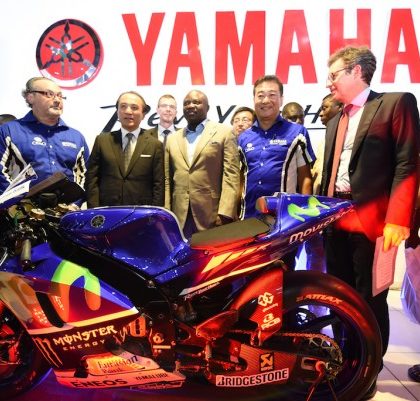
The CFAO YAMAHA assembly plant was officially opened in Lagos, Nigeria to assemble two motorcycle models: the Yamaha Crux and the Force X Royale, both destined for the Nigerian market. Located in the Amuwo Odofin industrial zone, the plant is expected to produce 70,000 units by 2018. A showroom will present other Yahama products such as outboard engines, personal watercrafts (WaveRunner), all terrain vehicles (ATV), generateurs and Yamalube lubricant products. In Nigeria, all of these products will be exclusively distributed by CFAO Yamaha Motor Nigeria Limited. The assembly plant and showroom inaugurated last Friday are the result of a partnership signed between CFAO and Yamaha at the end of 2014. This partnership aims at meeting demand from the Nigerian market and supporting the government’s drive to strengthen the country’s industrial base. According to Richard Bielle, Chairman of the Management Board of CFAO: “The strength of this partnership builds on Yamaha’s manufacturing expertise and CFAO’s sales expertise and vast distribution network. The inauguration of this plant celebrates CFAO’s strategic redeployment in Nigeria in our three business sectors: equipment & services, healthcare and consumer goods.” The assembly plant also houses the Yamaha Technical Academy, a training centre for technical professionals, and the Yamaha Riding Academy, a road safety awareness centre. About CFAO CFAO is a front-ranking specialized distributor and preferred partner of major international brands, serving the high-potential equipment & services, healthcare and consumer goods markets in Africa and the French overseas territories. The Group is active in 39 countries, including 34 African countries and 7 French Overseas Territories. It employed 12,370 people at end-2015. In 2015, CFAO generated consolidated revenue of €3,435.7 million and recorded recurring operating income of €269.2 million. CFAO is a 97.74%-owned subsidiary of TTC (Japan). CFAO is listed on NYSE Euronext Paris.
Ethiopia has adopted a new system to tackle trade under-invoicing that costs the country an estimated $2 billion every year. Ethiopia Customs and Revenue Authority has linked its new Customs database to global price makers which updates itself automatically. The new system will help detect cases where importers under-invoice the value of their goods in order to reduce their import duties. “We are also identifying the major importers in the country for close follow-up by our intelligence unit. We also have a plan to pay up to 10 per cent of the recovered tax money to members of the public who inform us of tax fraud,” said Sisay Bikaru, director of Ethiopia Customs and Revenue Authority (ERCA). According to reports, Ethiopia loses $1.97 billion every year through trade under-invoicing, and a further $630 million every year through illicit financial flows. The losses constitute five to 10 per cent of the country’s GDP. Uganda, Tanzania and DR Congo lose about $720 million, $480 million and $225 million annually to illicit flows. In Africa, South Africa is ranked top at $20.9 billion lost through illicit flows annually, followed by Nigeria at $17.8 billion, Morocco at $4.1 billion, Egypt at $3.9 billion, Zambia at $2.8 billion and Cote d’Ivoire at $2.3 billion. Ethiopia’s tax to GDP ratio stands at 13 per cent, compared with 15 per cent for sub-Saharan Africa. According to recent reports developing countries lose $85 billion a year through trade under-invoicing, with China losing the most through illicit financial flows.
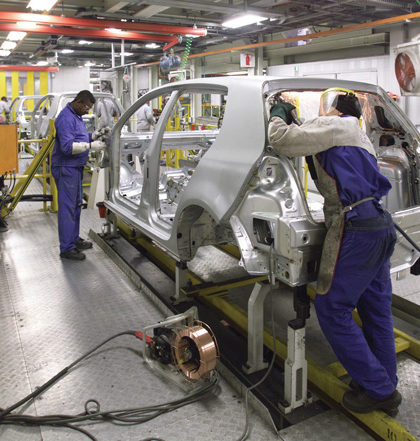
Ethiopia has plans to expand its nascent auto industry, aiming to convert its small base of local assemblers that put together imported kits and transform them into a network of factories that can make the country Africa's biggest car manufacturer over the next two decades. expanding Ethiopia's auto industry is part of a longterm plan to turn Ethiopia into an industrial centre by constructing new industrial zones around Addis Ababa and the northern city of Mekelle, where Ethiopian firms and Chinese partners assemble vehicle kits. Ethiopia produces about 8,000 commercial and other vehicles a year for the home market, about a quarter of which are cars. But executives say they have capacity to make more if they could obtain extra foreign exchange to import kits in greater numbers. The nation imported more than 38,000 assembled cars in 2015, a more than 50 percent increase over the previous year. "There is a lot of potential for growth," said Ma Qun, deputy manager of China's Lifan auto group in Ethiopia, which has the capacity to assemble 5,000 cars a year but whose output is less than a fifth of that. "We want to start exporting from Ethiopia by 2018, or a year later," he said. For now, Ethiopia is a minnow in African terms. South Africa and Morocco are involved in the full manufacture of vehicles annually making more than 600,000 and 200,000, respectively. Egypt, Sudan and Kenya also assemble vehicles. Assemblers in Ethiopia, which put together Chinese brands Geely, FAW and BYD as well as Lifan, face other hurdles, notably in obtaining dollars to import kits given the Ethiopia's scant currency reserves. They are also battling to reassure consumers about quality. But Ethiopia has delivered on ambitious targets before, boasting one of Africa's fastest growing economies for more than a decade. New dams have turned the country into an electricity exporter and it has a rapidly expanding transport network. "The aim is to become a leading manufacturing hub in Africa," saysTadesse Haile, State Minister for Industry. "We want to become the top producer of cars on the continent in 15 or 20 years." An electrified railway will soon link the land-locked nation of 97 million people to Djibouti port where the Red Sea meets the Indian Ocean, providing a cheap and fast way to import raw materials and export finished goods. China, which has become a close development partner for a nation whose state-led economic model has closely mirrored the Chinese approach, is building the railway. Chinese car firms are now at the centre of Ethiopia's vehicle manufacturing plans. An executive at one Ethiopian manufacturer said Chinese car kits were cheaper than those from rivals, such as in Japan. "They are helping us in marketing," he added, asking not to be identified. Ethiopia desperately needs a new fleet of cars. The streets of Addis Ababa are filled with dilapidated vehicles. Some of the ubiquitous blue and white taxis are rattling Soviet-era Ladas built in the 1980s. Many of its imports are used vehicles. A new middle class is slowly emerging to push up demand, even though the growth forecast for 2016 has been cut to 7 percent from 10 percent because of a drought that has left 10 million people hungry. To encourage the industry, Ethiopian-assembled cars receive tax breaks when local input exceeds 10 percent. One of the Geely models put together in Ethiopia sells for 300,000 birr ($14,000), while an already completed imported version would cost about 450,000. A 10-year-old Japanese-built Toyota Corolla, by comparison, also sells for about 450,000 birr. The industry is still based on fixing together "semi-knockdown" kits that come in a 1,000 or so pieces each. But the aim is to shift to "complete knockdown" kits, requiring greater local input, in five years or less, the minister said. "We are working on that," said Endalkachew Mekonnen, automotive marketing manager at Mesfin Industrial Engineering, which assembles Geely sedans. His firm plans to use "complete knockdown" sets in the next two years, he added. Mesfin assembles Geely's CK1 and SL sedans, Belayab Motors puts together FAW Vela saloons, while Betret International in partnership with BYD makes the BYD-F3 sedan. The biggest producer Lifan offers vehicles ranging from its 530 sedan to the X50 and X60 SUVs. The commercial truck business is dominated by state-owned METEC, which assembles SINOTRUK and other models, executives said. Some pickups and tractors are also assembled in Ethiopia. A major constraint on the car industry is sourcing dollars. "For example, if we apply for $500,000 for a month's worth of shipments, the bank will give us $200,000 for two months," Lifan's Ma said. "This is a challenge." Similarly, Belayab Motors completes about 500 cars a year, but an executive said it could lift output to 1,000 with extra shifts and more dollars. With huge infrastructure projects the priority, the central bank is frugal when doling out foreign exchange on imports. Ethiopia's foreign reserves were $3.3 billion at the end of June last year, the equivalent of just two months of imports, according to the International Monetary Fund. Neighbouring Kenya usually has four months cover and, for now, has five months. "We are working on improving conditions for all manufacturers. We hope to ease shortages in the near future," minister Tadesse said. The IMF has urged Ethiopia to offer more support for private business. "Success going forward will depend critically on a greater role for the private sector," it said in September. The list of foreign investors in Ethiopia is growing, ranging from brewer Heineken to private equity firm Kohlberg Kravis Roberts (KKR). But the tight currency controls are cited by potential investors as a major deterrent. Ethiopia's car assemblers face another challenge, namely that their cars do not hold their prices as well as finished imports. "The big obstacle they face is resale value," said Araya Lakew, whose mekina.net website links buyers and sellers. Some used imports, such as Toyotas, even rise in birr terms with the weaker currency, unlike locally assembled models. Lifan's marketing director Tomi Su said his firm would keep making their models more attractive to consumers. "There will be new gadgets in every upgrade," he said.
Preliminary request for participation in the trade show
place
calendar_today
Preliminary request for visitor registration
Visitor Registration
place
calendar_today